
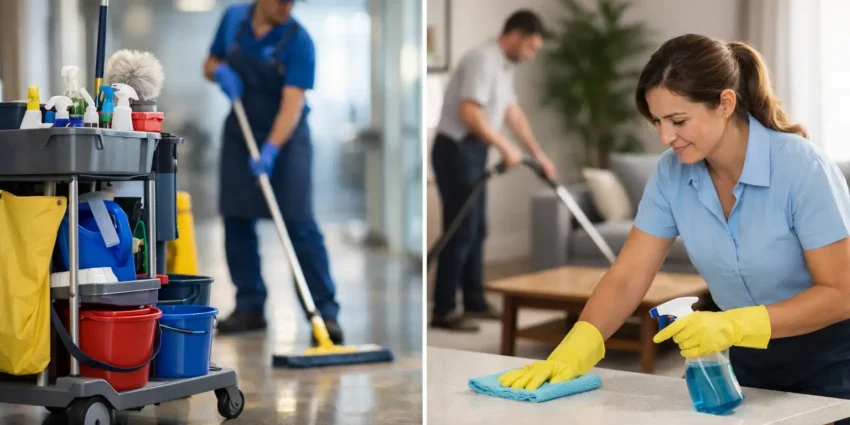
When a restroom is missed before a tenant tour or lobby floors still look dull after a busy day, the cleaning model behind the work starts to matter fast. For many businesses, the question is not whether cleaning needs to happen. It is whether janitorial services vs in house cleaning makes more sense for the building, the budget, and the daily operation.
For office managers, property managers, hospitality operators, and facility teams, this decision affects more than appearance. It impacts staffing, supply costs, consistency, liability, and how much time your team spends managing work that sits outside your core business. A clean facility supports employee morale, customer confidence, and day-to-day operations, but the right setup depends on what kind of facility you run and how much oversight you want to carry internally.
Janitorial services vs in house cleaning: what is the difference?
In house cleaning means you hire and manage your own cleaning staff as employees. Your business handles recruiting, training, scheduling, payroll, supplies, equipment, quality control, and coverage when someone is absent. This gives you direct control, but it also places the full management burden on your internal team.
Janitorial services means you hire a commercial cleaning company to provide scheduled cleaning under a service agreement. The provider supplies trained cleaners, manages staffing, brings a system for quality control, and typically handles scheduling, supervision, and replacement coverage. For many commercial properties, this shifts cleaning from an internal staffing function to an outsourced service with defined expectations.
On paper, both options can keep a building clean. In practice, they operate very differently.
Cost is not just hourly pay
A lot of businesses first compare the hourly wage of an in house cleaner to the contract rate of a janitorial company. That is a starting point, but it is rarely the full picture.
With in house cleaning, labor costs are only one line item. You also have payroll taxes, benefits, hiring time, workers’ compensation, turnover, training, equipment purchases, chemical inventory, and the cost of supervision. If a cleaner calls out, someone on your team still has to solve the problem. That lost management time has a real cost, even if it does not show up clearly on a cleaning spreadsheet.
With janitorial services, pricing is usually more predictable. You are paying for a scope of work, a schedule, labor management, and operational oversight. That can make budgeting easier, especially for offices, hospitality properties, and multi-tenant buildings that need dependable service on the same day and time. Transparent pricing matters here. A low quote that turns into added charges for supplies, floor care, or extra visits is not really a low quote.
If your facility is small and your cleaning needs are simple, in house may look less expensive at first. If your property has multiple restrooms, public-facing areas, changing occupancy, or specialized cleaning needs, outsourced janitorial service often becomes more cost-efficient over time.
Control vs management burden
The biggest advantage of in house cleaning is control. You hire the staff, set priorities directly, and can adjust tasks in real time. Some organizations prefer that because cleaning is tightly tied to their culture or daily workflow.
But control comes with responsibility. Someone has to inspect the work, coach the team, reorder supplies, manage time off, and handle performance issues. For a busy office manager or facility coordinator, that can turn into one more department to run.
Janitorial services reduce that management load. A professional vendor should have supervisors, systems, and clear communication channels in place. Instead of managing individual cleaners, you manage the service outcome. That is often a better fit for businesses that want reliable cleaning without having to micromanage staffing every week.
This is where many companies in the Puget Sound market make their decision. If your internal team is stretched thin already, adding cleaning oversight may not be the best use of their time.
Staffing reliability can make or break the choice
Cleaning is one of those functions people only notice when it fails. Trash overflow, dirty glass, or neglected restrooms quickly become visible to employees, customers, guests, and tenants.
In house teams can work well when you have stable staff and strong internal supervision. The challenge is coverage. Vacation, sick days, turnover, and hiring gaps can create service interruptions. If one cleaner handles a large share of the work, a single absence can disrupt the entire building.
A janitorial company is usually better positioned to provide backup coverage. That matters for commercial spaces that cannot afford skipped service, including hotels, restaurants, dealerships, medical-adjacent offices, and high-traffic office buildings. Dependability is not a nice extra. It is part of keeping the property operational and presentable.
A licensed and insured commercial cleaning provider also adds a layer of protection that many businesses value. If something goes wrong, there is an established service structure behind the work rather than a single employee arrangement that depends heavily on one person.
Quality depends on systems, not good intentions
Many businesses assume in house cleaning will automatically produce better quality because the team is on payroll. Sometimes that is true. More often, quality depends on whether there is a real system behind the work.
Commercial janitorial companies tend to bring checklists, training procedures, task rotation, and experience across different building types. That matters when cleaning goes beyond wiping surfaces and emptying trash. Floor care, touchpoint disinfection, restroom sanitation, breakroom maintenance, and post-construction cleanup all require process and attention to detail.
An in house team may perform very well in a simple office environment. But if your facility includes warehouses, hospitality spaces, showrooms, or construction turnover areas, the work often gets more technical. Specialty environments benefit from crews that handle commercial cleaning every day and understand the demands of those settings.
The real question is not who cares more. It is who has the right systems, training, and accountability to deliver consistent results.
When in house cleaning makes sense
There are situations where building an internal cleaning team is a reasonable choice. If you operate a single site with highly specific routines, need daytime staff fully integrated into operations, or already have strong facilities management infrastructure, in house cleaning may fit.
It can also make sense when your cleaning needs shift constantly throughout the day and you want immediate task reassignment without going through a service request process. In those cases, having someone on staff can feel more flexible.
Still, this model works best when you are prepared to manage it properly. Without training, oversight, and backup coverage, the benefits of in house control can disappear quickly.
When janitorial services are the better fit
Janitorial services are often the better option for businesses that need consistency, predictable scheduling, and less internal management. That includes many offices, multi-site operations, hotels, restaurants, warehouses, auto dealerships, and post-construction projects.
This model is especially helpful when cleaning has to happen after hours, on a recurring schedule, or across spaces with different service demands. A professional provider can scale service up or down, bring the right equipment, and maintain continuity even when individual cleaners change.
For businesses that value clear communication, no hidden fees, and reliable execution, outsourced cleaning removes a common source of operational friction. That is one reason many companies choose a commercial specialist like Armani Janitorial rather than trying to build and supervise a cleaning department internally.
How to choose the right model for your property
Start with your building’s actual needs, not assumptions. Consider square footage, traffic level, restroom usage, flooring types, public visibility, and whether you need standard recurring cleaning or specialty support. Then look at your team’s capacity. If your staff is already managing vendors, maintenance issues, tenant requests, and daily operations, taking on cleaning oversight may create more strain than value.
It also helps to think about risk. What happens if your cleaner quits unexpectedly? What happens if quality slips for two weeks before someone catches it? What happens if you need added service during a busy season or after a construction project? The right cleaning model should hold up under normal conditions and under pressure.
A practical way to decide is to compare total cost, not just wage rate, and weigh it against reliability and management time. The cheapest option on paper is not always the least expensive to live with.
For many commercial properties, the best choice comes down to this: if cleaning is essential but not something your team wants to manage closely, janitorial service is usually the stronger operational fit. If you have the time, infrastructure, and need for direct daily control, in house cleaning can work well.
A clean building reflects how your business runs. The right cleaning setup should make your job easier, not give you one more problem to solve.