
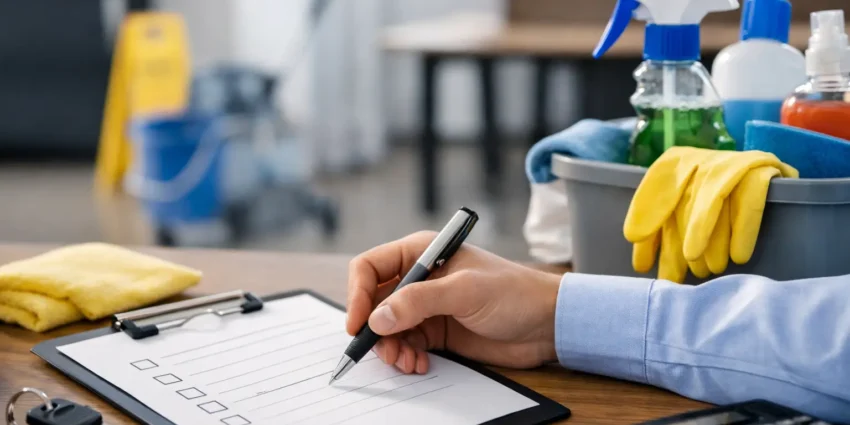
A cleaning proposal can look solid on paper and still create problems a month later. Missed tasks, unclear schedules, extra charges, and slow responses usually trace back to one issue – the agreement was never clear enough to begin with. A strong janitorial contract checklist helps business owners and facility teams catch those issues before service starts.
If you manage an office, hotel, restaurant, warehouse, dealership, or post-construction site, the contract matters just as much as the quote. Price is part of the decision, but reliability, scope, accountability, and communication are what determine whether the service actually reduces your workload.
What a janitorial contract checklist should do
A contract should not just protect the cleaning company. It should protect your operation. That means defining what gets cleaned, how often it gets cleaned, who is responsible for supply management, and what happens when something needs to be corrected.
The best agreements are specific without becoming hard to use. If the contract is too vague, you leave room for inconsistent service. If it is overloaded with generic language, you can miss the few details that matter most for your building. A useful checklist keeps the focus on service quality, budget control, and day-to-day accountability.
Start with a clear scope of work
The first thing to review is the scope of work. This is where many contracts become too broad. Terms like general cleaning or full janitorial service may sound complete, but they do not tell you what your team should expect on a daily, weekly, or monthly basis.
A better scope breaks cleaning into real tasks tied to your facility. In an office, that may include restroom sanitation, trash removal, breakroom cleaning, vacuuming, dusting, and touchpoint disinfection. In a warehouse, the scope may need to address floor debris, restroom upkeep, and cleaning around loading or staff areas. In hospitality settings, expectations are usually higher and more detailed because presentation affects the guest experience.
If your property has specialty needs, those should be named directly. Post-construction cleanup, floor care, window cleaning, pressure washing, and high-dust removal should never be assumed to be included unless they are written into the contract.
Confirm the schedule in writing
A good janitorial contract checklist always includes service frequency and timing. This sounds simple, but it is often where frustration begins. A contract should state whether service is nightly, several times per week, weekly, or on a custom schedule. It should also clarify whether work happens during business hours, after hours, or on weekends.
Consistency matters. Many businesses do not want rotating service windows that disrupt staff or customers. If you expect service at the same day and time, that should appear in the agreement. If there is flexibility because of building access or seasonal traffic, that should be documented too.
For facilities with multiple service levels, the schedule should reflect that. Daily restroom cleaning and weekly detailed dusting are not the same thing. When frequencies are listed by task, there is less room for confusion later.
Review pricing beyond the base quote
A low monthly number can hide a lot. One of the most practical parts of reviewing a contract is understanding exactly what the price covers and what triggers additional charges.
Look for a clear monthly or per-visit rate, but also review how the contract handles supply replenishment, emergency callouts, special projects, deep cleaning, floor treatment, and after-hours requests. If the contract is silent on those items, ask for clarification before signing.
Transparent pricing should feel straightforward. You should know whether consumables like paper products, soap, trash liners, and can liners are included or billed separately. You should also know whether the contract allows rate increases during the term and, if so, how much notice is required.
No hidden fees is not just a marketing phrase. It should be supported by contract language that makes billing predictable.
Make sure staffing and qualifications are addressed
The people entering your facility matter. Your checklist should include confirmation that the janitorial company is licensed and insured, and that coverage applies to the type of commercial work being performed.
It is also worth checking how the provider staffs the account. You do not necessarily need every internal hiring detail, but you should know whether cleaners are employees or subcontractors, whether there is supervision, and who your point of contact will be if something needs immediate attention.
For businesses with security concerns, ask how keys, alarm codes, and access credentials are handled. For medical-adjacent, hospitality, and high-traffic commercial properties, ask whether teams are trained for the specific environment. Not every cleaner is equipped for every facility type.
Include quality control expectations
A contract should explain how service quality is measured. If there is no process for inspections, reporting, or correction, you may end up repeating the same complaints without resolution.
A reliable provider should define how you report issues, who responds, and how quickly corrections are made. Some businesses want a formal inspection log. Others just want a responsive account manager who handles concerns without delay. Either approach can work, but the expectation needs to be set.
This is also where it helps to define what counts as acceptable service. Restrooms, entryways, customer-facing floors, and high-touch areas usually require a higher standard than back-of-house spaces. The contract does not need to read like a training manual, but it should show that the service level matches the building’s priorities.
Check supplies, equipment, and site responsibilities
Not every janitorial agreement is structured the same way. In some contracts, the cleaning company provides all equipment and cleaning products. In others, the customer supplies certain consumables or requests approved products for specific surfaces.
Your checklist should identify who provides vacuums, mops, chemicals, paper goods, liners, and dispensers. It should also state whether there are green cleaning requirements, fragrance restrictions, or product limitations for sensitive spaces.
Site responsibilities matter too. If the building must provide janitor closet access, water, power, or secure storage space, that should be spelled out. Small operational details can cause recurring service issues when no one addresses them early.
Pay attention to term length and cancellation terms
Contract length deserves more attention than it usually gets. Some businesses want a longer agreement for price stability and service continuity. Others prefer shorter terms while they evaluate performance. Neither approach is automatically better. It depends on how predictable your needs are and how confident you feel in the provider.
What matters most is understanding renewal terms, cancellation notice periods, and any early termination fees. Automatic renewals can be convenient, but only if they are clear. If the service is not meeting expectations, you should know what process is required to end the agreement without a dispute.
It is also smart to review the language around service failures. If the provider repeatedly misses visits or fails to correct issues, the contract should not leave you stuck in a one-sided arrangement.
Use a janitorial contract checklist for site-specific needs
Commercial cleaning is never one-size-fits-all. A contract for a professional office will not look the same as one for a hotel, restaurant, or construction turnover. Your janitorial contract checklist should reflect the type of property you run.
For offices, consistency and low disruption are usually the priority. For hospitality, presentation speed and responsiveness are critical. For restaurants, sanitation standards and grease-prone areas need closer attention. For warehouses, safety and debris control may matter more than cosmetic detailing in every zone. Post-construction properties need explicit language around dust, debris, surface protection, and final presentation.
This is where local experience helps. A provider that regularly services commercial facilities across different industries is more likely to spot what should be included before it becomes a problem.
Questions worth asking before you sign
If you are comparing providers, ask them to walk you through the contract in plain language. A dependable company should be able to explain what is included, what is optional, how issues are handled, and who owns follow-through.
Ask what happens if your hours change, if your square footage expands, or if you need temporary extra service during a busy season. Ask how quickly they can respond to an urgent cleanup. Ask how they document completed work. The right partner will not treat those questions like obstacles. They will answer them clearly because clear expectations lead to better service.
At Armani Janitorial, that practical approach matters because most business owners do not need more complexity. They need a cleaning partner who shows up, communicates well, and does the work the way it was promised.
A contract should make your job easier, not tie you to avoidable headaches. When the details are clear from day one, you are far more likely to get consistent service, fair billing, and a cleaner facility that reflects well on your business.