
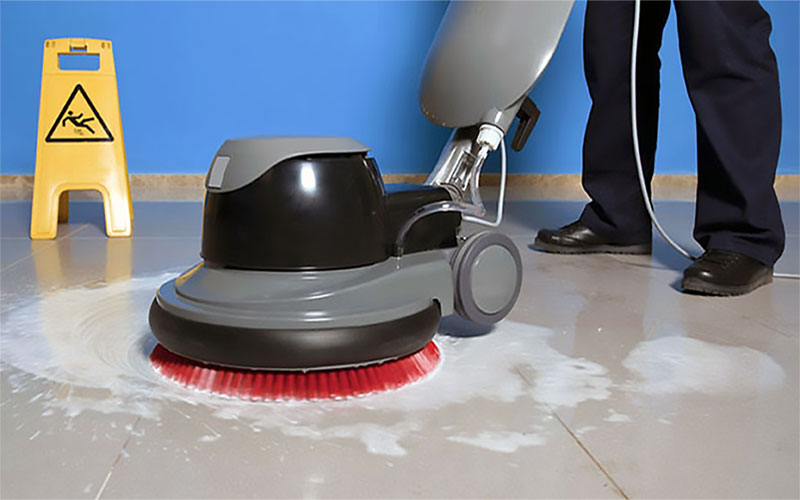
Rotary machines are one of the most versatile tools in professional floorcare. They use a single rotating disc or brush mounted beneath the machine to clean, polish, scrub, strip, or buff different types of flooring. You’ll often see them in commercial buildings, schools, hospitals, hotels, and large retail spaces because they can handle many floor maintenance tasks with interchangeable pads and brushes.
What a Rotary Machine Does
A rotary floor machine spins a pad or brush in a circular motion, typically between 150–400 RPM (rotations per minute) for standard units, though high-speed burnishers can run much faster.
Depending on the attachment used, the machine can:
- Scrub hard floors
- Strip old floor finish
- Polish or buff surfaces
- Shampoo carpets
- Sand wood floors
- Deep clean tile and grout
Where Rotary Machines Fit in Floorcare
Rotary machines are usually part of a broader floor maintenance system alongside:
- Vacuum cleaners
- Auto scrubbers
- Sweepers
- Burnishers
- Extractors
They’re especially valuable because one machine body can perform multiple functions just by changing accessories.
Common Floorcare Applications
| Task | How Rotary Machines Help |
|---|---|
| Daily cleaning | Light scrubbing and spray cleaning |
| Restorative cleaning | Removing embedded soil and old coatings |
| Floor stripping | Removing wax or finish before recoating |
| Polishing | Enhancing gloss on finished floors |
| Carpet care | Shampooing or bonnet cleaning |
| Stone maintenance | Honing and crystallizing marble or terrazzo |
Main Types of Rotary Machines
Standard-Speed Rotary Machines
Usually around 175 RPM. These are the most common and are ideal for:
- Scrubbing
- Stripping
- Shampooing
- General-purpose cleaning
High-Speed Machines
Typically 300–400 RPM. Used for:
- Spray buffing
- Intermediate polishing
Ultra High-Speed Burnishers
Can exceed 1,000 RPM. Best for:
- Producing high-gloss finishes on commercial floors
Pads and Brushes Matter
The machine itself is only part of the system. Different pads determine the result:
| Pad Color | Typical Use |
|---|---|
| Black | Heavy stripping |
| Green | Aggressive scrubbing |
| Red | Light cleaning/spray buffing |
| White | Polishing |
Brushes are also selected based on floor texture and material.
Advantages in Professional Floorcare
- Multi-purpose functionality
- Lower equipment costs versus multiple dedicated machines
- Effective deep cleaning
- Suitable for many floor surfaces
- Long service life
Limitations
- Requires operator training
- Can be physically demanding
- Circular motion may leave swirl marks if used incorrectly
- Less efficient than auto scrubbers for very large open areas
Typical Industries Using Rotary Machines
You’ll commonly find rotary floor machines in:
- Healthcare facilities
- Educational campuses
- Airports
- Hospitality venues
- Warehouses
- Retail stores
Summary
Rotary machines are a foundational tool in commercial floorcare because they combine versatility with deep-cleaning power. While newer technologies like auto scrubbers and robotic cleaners are increasingly common, rotary machines remain essential for detailed maintenance, restoration work, stripping, and polishing tasks that require flexibility and operator control.