
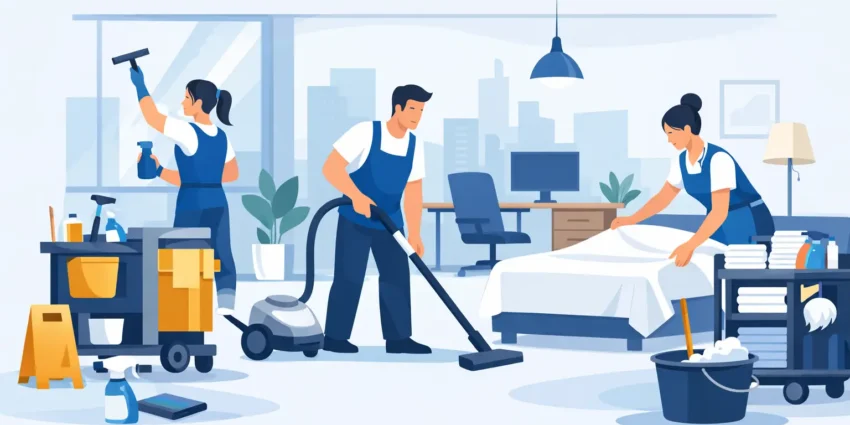
A lobby can look clean at 8 a.m. and worn down by noon. Trash builds up, restrooms need attention, fingerprints show up on glass, and shared spaces start sending the wrong message fast. That is where the answer to what is commercial housekeeping services becomes practical, not theoretical. It is the day-to-day work that keeps a business clean, presentable, sanitary, and ready for employees, customers, guests, and inspections.
Commercial housekeeping services are ongoing cleaning and upkeep tasks performed in business environments. Unlike one-time deep cleaning, this work is built around routine care. It focuses on maintaining the appearance, cleanliness, and usability of a facility on a scheduled basis, whether that means daily office cleaning, regular restroom sanitation, lobby upkeep, breakroom cleaning, trash removal, floor care, or touchpoint disinfection.
What Is Commercial Housekeeping Services in Simple Terms?
In simple terms, commercial housekeeping services keep a commercial property consistently clean instead of letting messes build up until they become a bigger problem. The goal is not just to make a space look better. It is also to support health, safety, employee comfort, customer perception, and smoother day-to-day operations.
That matters in almost every commercial setting. Offices need clean desks, restrooms, and shared spaces. Hotels and hospitality properties need a polished appearance at all times. Restaurants need front-of-house cleanliness that matches back-of-house standards. Warehouses and auto dealerships have different cleaning needs, but they still rely on consistent upkeep to protect both appearance and workflow.
For many businesses, housekeeping is not a luxury line item. It is part of running a professional facility.
What Commercial Housekeeping Usually Includes
The exact scope depends on the building, traffic level, and schedule, but most commercial housekeeping services cover a core set of routine tasks. These often include dusting surfaces, vacuuming carpet, mopping hard floors, emptying trash, cleaning and restocking restrooms, wiping breakrooms, cleaning glass, and sanitizing high-touch areas such as door handles, counters, switches, and shared equipment.
In larger or more specialized properties, housekeeping may also include elevator detailing, lobby presentation, spot cleaning walls, stairwell upkeep, odor control, floor maintenance, and supply monitoring. In hospitality environments, the standard may be higher and the pace faster because guest-facing areas can change quickly throughout the day.
This is one reason commercial cleaning proposals can look different from one company to another. One business may need three visits per week after hours. Another may need daytime porter support, daily restroom checks, and weekly floor work. There is no single package that fits every facility.
Commercial Housekeeping vs. Janitorial Services
These terms are often used interchangeably, and in many cases that is fine. Still, there can be a slight difference in how people use them.
Commercial housekeeping usually refers to the ongoing cleanliness and appearance of occupied business spaces. It has a maintenance mindset. The work is about keeping the property in order every day or every week.
Janitorial services can include that same routine work, but the term is sometimes broader. It may also cover supply management, more structured cleaning programs, or building support tasks tied to a contract. Some companies use “housekeeping” more often in hospitality or high-traffic interior spaces, while “janitorial” is common in offices, schools, medical support spaces, industrial properties, and general commercial facilities.
The more useful question is not which label a company uses. It is whether the service scope matches your building and whether the provider can deliver it on time and consistently.
Who Needs Commercial Housekeeping Services?
Any business that serves employees, customers, tenants, patients, guests, or vendors in a physical location can benefit from commercial housekeeping. The need becomes more obvious in buildings with steady foot traffic, public-facing areas, shared restrooms, food service, or multiple shifts.
Office managers often rely on housekeeping to keep workspaces professional without asking staff to handle cleaning tasks. Property managers use it to protect tenant satisfaction and property value. Hospitality operators need it because appearance affects guest experience immediately. Post-construction sites may need a different level of cleanup at first, then transition into regular housekeeping once the building is active.
For some businesses, daily service makes sense. For others, several visits per week are enough. It depends on occupancy, the type of work being done, and how quickly the space gets dirty.
Why Businesses Outsource Instead of Handling It In-House
On paper, in-house cleaning can look simple. In practice, it often creates more moving parts than expected. Someone has to hire, train, supervise, schedule, cover call-outs, track supplies, and manage quality. If standards slip, the same manager who already has too much on their plate ends up chasing cleaning issues too.
Outsourcing commercial housekeeping gives businesses a cleaner process along with a cleaner building. A professional provider comes in with trained staff, defined scopes of work, scheduling systems, and the equipment needed to do the job right. That reduces the burden on internal teams and usually improves consistency.
There is also the liability side. Businesses often prefer working with a licensed and insured commercial cleaning company because it lowers risk and creates clearer accountability. For busy facility leaders, that matters as much as the cleaning itself.
What Good Commercial Housekeeping Looks Like
Good housekeeping is not flashy. It is dependable. Trash is removed before it overflows. Restrooms stay stocked and sanitary. Floors stay presentable. Problem areas are noticed early. The building feels cared for, even when nobody is thinking about the cleaning crew.
That consistency is what many businesses are really buying. They do not want to explain the same issues every week or wonder whether the team will show up. They want a service partner who understands the property, follows the schedule, communicates clearly, and handles the work without creating extra management.
A good provider should also be realistic about what can be handled during routine service and what falls into specialty cleaning. Carpet extraction, floor stripping and waxing, post-construction cleanup, or heavy-duty degreasing may require separate scheduling or pricing. Clear expectations upfront prevent frustration later.
What to Ask Before Hiring a Commercial Housekeeping Provider
The most useful questions are operational. How often will the crew be on-site? What tasks are included at each visit? Who checks quality? Are cleaners trained for commercial environments? Is the company licensed and insured? Are there any extra charges outside the quoted scope?
Pricing should be transparent, and the schedule should match the way your facility actually runs. A medical-adjacent office with steady traffic has different needs than a warehouse with a front office. A hotel lobby, restaurant, or auto dealership may need more frequent touch-up work because presentation changes hour by hour.
It is also worth asking how the company handles communication. If an issue comes up, you should know who to contact and how quickly you can expect a response. Cleaning quality matters, but responsiveness matters too.
What Affects the Cost?
Commercial housekeeping costs are usually based on square footage, frequency, building type, traffic, and the scope of work. A small office cleaned twice a week will price differently from a large multi-tenant facility with daily restroom service and floor care.
The cheapest quote is not always the best value. Low pricing sometimes means light staffing, rushed visits, vague task lists, or hidden add-ons later. On the other hand, the highest quote is not automatically better either. The right fit is a provider that can clearly explain the service plan, stick to the schedule, and deliver consistent results within budget.
That balance matters for long-term contracts. A cleaning partner should make operations easier, not create more follow-up work.
Why It Matters More Than People Think
Cleanliness affects how a business is perceived long before anyone comments on it. Employees notice when restrooms are neglected. Customers notice smudged glass and dirty entryways. Tenants notice when common areas feel ignored. Even if nobody says anything directly, the building starts sending a message.
Commercial housekeeping protects against that slow decline. It supports health standards, helps facilities stay organized, and keeps spaces ready for daily use. It can also extend the life of flooring, fixtures, and surfaces by preventing dirt buildup and deferred maintenance.
For businesses across offices, hospitality, retail-adjacent spaces, warehouses, and post-construction transitions, regular upkeep is part of protecting the property and the brand. That is why companies across the Puget Sound area work with commercial specialists like Armani Janitorial when they need reliable service, clear pricing, and a crew that shows up ready to work.
If you are deciding whether your facility needs commercial housekeeping, the real question is simple: do you want cleaning to be another daily problem, or one less thing to think about? The right service should make the answer easy.