
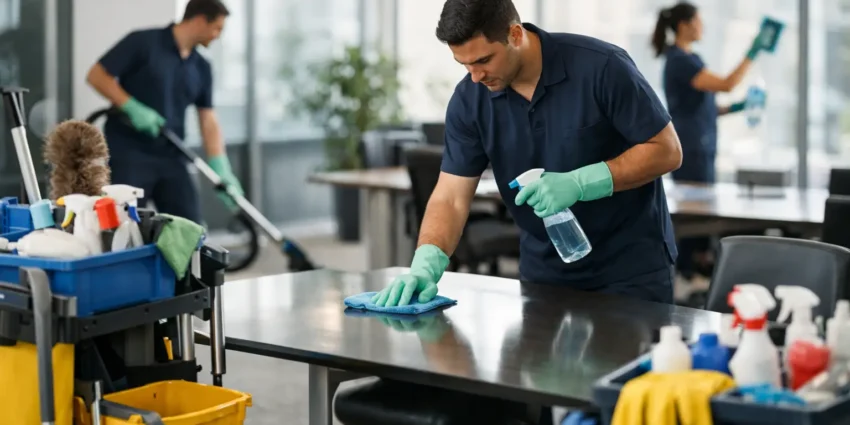
If you are comparing vendors and keep seeing the phrase commercial cleaning services, the first thing to know is that commercial cleaning services meaning goes far beyond basic tidying. It refers to professional cleaning performed in business environments like offices, restaurants, hotels, warehouses, medical-adjacent facilities, and post-construction sites. The goal is not just to make a space look clean. It is to keep operations presentable, sanitary, safe, and ready for staff, customers, and inspections.
For busy property managers and business owners, that distinction matters. A true commercial cleaning provider is built around business schedules, facility requirements, liability standards, and recurring service expectations. That is very different from hiring someone to clean a home or handle occasional light upkeep.
Commercial Cleaning Services Meaning in Simple Terms
In simple terms, commercial cleaning services are professional cleaning services designed specifically for commercial properties. That can include daily office cleaning, restroom sanitation, floor care, trash removal, breakroom cleaning, window cleaning, carpet care, and specialty work such as post-construction cleanup.
The word commercial is the key. It means the work is tailored to businesses, public-facing spaces, and larger facilities with more traffic, more compliance concerns, and less room for missed details. A restaurant has different cleaning demands than an office. A hotel has different priorities than a warehouse. A newly completed construction site needs a completely different level of dust and debris removal than a retail store that just needs nightly service.
That is why commercial cleaning is usually structured around scope, frequency, staffing, and accountability. It is not a one-size-fits-all service.
What Is Usually Included in Commercial Cleaning Services?
Most commercial cleaning agreements cover the routine tasks that keep a facility usable and professional day after day. In an office, that often means vacuuming, mopping, dusting, disinfecting touchpoints, emptying trash, and cleaning restrooms and kitchens or breakrooms. In hospitality settings, it can include common area cleaning, lobby care, restroom attention, floor maintenance, and back-of-house support.
For industrial or high-traffic environments, the scope may expand to include heavier floor care, grease removal, warehouse dust control, or cleaning around operational equipment. Post-construction cleaning is another category entirely. That work typically focuses on fine dust, adhesive residue, debris removal, surface detailing, and getting the property ready for turnover or occupancy.
The exact service list depends on the building type, hours of use, and the standard the client needs to maintain. A professional provider should walk the site, identify priorities, and build a cleaning plan around the property rather than forcing the property into a fixed package.
Commercial Cleaning vs. Janitorial: Is There a Difference?
People often use these terms interchangeably, and in everyday conversation that is understandable. But there can be a useful distinction.
Janitorial service usually refers to recurring, ongoing maintenance cleaning. Think nightly office cleaning, restroom restocking, trash removal, and keeping the facility consistently presentable. Commercial cleaning is a broader term. It can include janitorial services, but it also covers more specialized tasks like floor stripping and waxing, carpet extraction, deep cleaning, window cleaning, and post-construction cleanup.
So if you are asking about commercial cleaning services meaning, the easiest way to think about it is this: janitorial is often the routine maintenance side, while commercial cleaning includes both routine and specialty cleaning for business properties.
That said, it depends on the company. Some providers use commercial cleaning as the umbrella term for all services they offer. Others separate recurring janitorial work from project-based specialty cleaning. The important thing is not the label. It is whether the scope matches your building’s actual needs.
Why Businesses Use Commercial Cleaning Services
Most businesses do not hire a commercial cleaning company just to save time, though that is part of it. They hire one because cleanliness affects operations, employee experience, customer perception, and risk.
An office with dirty restrooms and overflowing trash sends the wrong message to staff and visitors. A hotel with poorly maintained common areas loses credibility fast. A restaurant that falls behind on sanitation is dealing with more than appearance. A construction project that is not cleaned properly before turnover can delay handoff and create frustration for owners, tenants, or buyers.
Professional commercial cleaning helps reduce those issues by creating consistency. It gives decision-makers a schedule, a defined scope, and a provider who is responsible for results. That matters when you are managing tenants, employees, guests, or multiple vendor relationships and do not have time to chase down missed tasks.
What Commercial Cleaning Services Meaning Looks Like in Different Facilities
The meaning becomes clearer when you look at real facility types.
In an office, commercial cleaning usually centers on appearance, health, and routine upkeep. Employees want clean desks, floors, restrooms, and shared spaces. Visitors notice lobby presentation and overall order.
In a restaurant or food-service environment, the focus shifts toward sanitation, grease management, floors, restrooms, and front-of-house presentation. There is less margin for inconsistency because health and customer impression are directly tied to cleanliness.
In a warehouse, cleaning may involve dust control, floor cleaning, restroom upkeep, breakroom service, and attention to traffic patterns around loading or storage areas. The priority is often safety and functionality rather than polished presentation alone.
In hospitality settings, expectations are even higher. Guests notice floors, glass, restrooms, entryways, and odors almost immediately. Cleaning has to support the brand experience while staying on schedule.
On post-construction sites, the work is more technical. Fine dust settles everywhere, stickers and film need removal, and surfaces must be detailed carefully before the space is ready for occupancy. This is not basic janitorial work. It requires the right process, labor, and attention to finish quality.
What to Expect From a Professional Provider
A professional commercial cleaning company should offer more than labor. It should offer structure.
That means clear communication, defined schedules, a written scope of work, and pricing that makes sense before service begins. It also means showing up on time, performing consistently, and addressing issues quickly when they come up. For commercial clients, reliability is part of the service itself.
You should also expect proper insurance, trained cleaners, and an understanding of how to work in active business environments without creating disruption. That is especially important in occupied offices, hospitality properties, retail settings, and multi-vendor construction sites.
A dependable provider will also be honest about trade-offs. For example, a lower-frequency cleaning plan may reduce cost, but it may not hold up well in a high-traffic facility. A warehouse may not need the same detail level as a client-facing showroom, but it still needs a plan that supports safety and basic cleanliness. Good service starts with matching the scope to the real use of the building.
How to Tell if You Need Commercial Cleaning Services
If cleaning is inconsistent, complaints are increasing, or your internal staff is spending too much time on upkeep, it is probably time to look at commercial service. The same applies if your building has grown, your foot traffic has increased, or your current cleaner is unreliable.
Another sign is when cleaning needs become more specialized. That often happens after renovations, before inspections, during tenant turnovers, or when floor care and sanitation standards become harder to manage in-house.
For many businesses, outsourcing is less about cost alone and more about predictability. A commercial cleaning partner gives you a set schedule, a consistent point of contact, and fewer surprises. That is often worth more than trying to patch together cleaning coverage week by week.
Choosing the Right Commercial Cleaning Company
Not every cleaning company is set up for commercial work. Some handle small jobs well but struggle with recurring schedules, larger facilities, or specialized environments. That is why it helps to ask direct questions about experience, insurance, service frequency, response time, and what is actually included in the estimate.
Look for a company that understands your type of property and can explain its process clearly. If pricing is vague, scheduling is inconsistent, or the service scope feels generic, that is usually a warning sign. Commercial clients need dependable systems, not guesswork.
Companies like Armani Janitorial focus specifically on commercial environments, which matters when your priorities include staying on schedule, avoiding hidden fees, and keeping your property consistently ready for business. The right partner should make your job easier, not add another layer to manage.
Commercial cleaning services meaning is simple once you strip away the jargon. It means professional, scheduled, accountable cleaning built for business properties and business standards. If your facility needs to stay clean, safe, and presentable without constant follow-up, the best service is the one that fits your space, your schedule, and the level of reliability your operation demands.