
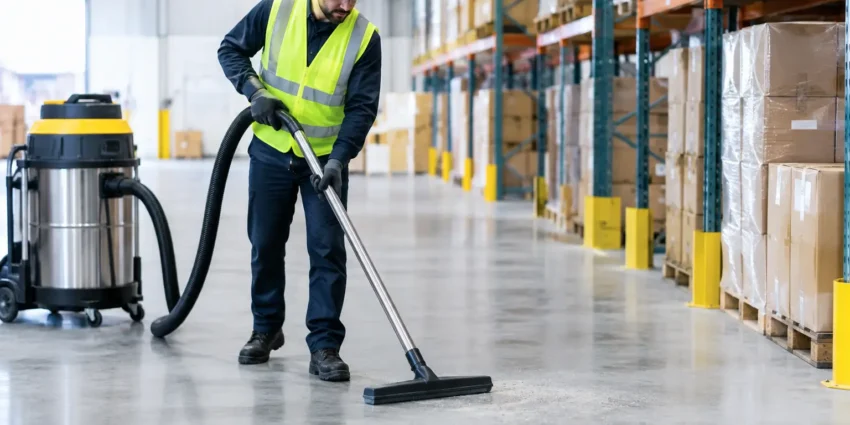
A warehouse can look orderly at floor level while dust is building up on racking, beams, dock doors, inventory, and equipment. That buildup eventually finds its way back into work areas, packaging, products, and ventilation systems. Effective warehouse dust control solutions address the source of the problem and establish a cleaning routine that keeps dust from becoming an ongoing operational issue.
For warehouse managers, the goal is not simply to make the building look cleaner before a customer visit. It is to create a safer, more efficient environment for employees, protect inventory, reduce avoidable cleanup work, and present a professional facility every day.
Why Warehouse Dust Becomes a Bigger Problem
Warehouses collect dust from more places than most facilities. Forklifts and foot traffic grind grit into concrete floors. Loading docks bring in dirt, cardboard fibers, exhaust residue, and moisture. Palletized goods shed debris, while stored materials can collect dust for months in hard-to-reach areas.
In the Puget Sound area, wet weather can add another challenge. Moisture tracked in at entrances and docks traps dirt on floors. Once it dries, that dirt can become fine dust again as equipment moves through the building. A quick sweep may improve appearances temporarily, but it can also push fine particles into the air and under shelving.
Dust creates practical concerns even when it is not immediately visible. It can affect product packaging, make floors harder to maintain, dirty vehicle cabs and office areas, and add to HVAC maintenance demands. In facilities that receive customer, vendor, or regulatory visits, heavy buildup on overhead surfaces or racking can also signal that routine cleaning is being missed.
Some materials require additional attention. Wood, grain, paper, metal, plastics, and certain chemical products may produce combustible or hazardous dust. Standard janitorial work is not a substitute for a site-specific safety assessment in these environments. Facility leaders should follow applicable safety requirements and work with qualified specialists when the type of dust, equipment, or process calls for it.
Warehouse Dust Control Solutions Start at the Source
A dependable plan begins by identifying where dust enters, where it is created, and where it settles. This sounds basic, but it prevents wasted effort. There is little value in repeatedly cleaning a dock aisle if damaged door seals, a dusty receiving process, or uncovered materials are reintroducing debris every shift.
Control what comes through the loading dock
Dock areas deserve regular attention because they are a main entry point for dirt and outdoor debris. Clean, well-maintained dock plates, entry mats, door tracks, and staging areas reduce the amount of material carried farther into the warehouse. Keeping exterior approaches reasonably clean also helps, especially near high-traffic receiving doors.
Material handling practices matter as well. Cardboard scraps, broken pallet pieces, stretch wrap, and loose packing materials should be removed as part of the daily workflow rather than allowed to accumulate in corners. When debris sits in traffic lanes, forklifts break it down into smaller particles that are harder to remove.
Match floor care to the floor and traffic level
Concrete floors are the foundation of most warehouse dust-control programs. The right approach depends on square footage, floor condition, traffic volume, and the type of debris present. In many facilities, vacuum-assisted sweeping or mechanical sweeping is more effective than dry sweeping because it captures fine particles rather than redistributing them.
Auto-scrubbing may be appropriate for sealed concrete and high-traffic areas, but it is not a universal answer. Floors need sufficient dry time, and cleaning methods should fit the surface condition and operations. A poorly planned wet-cleaning schedule can create slip risks or disrupt picking, receiving, and shipping activity.
High-use zones usually need more frequent service than the entire warehouse. Aisles near docks, break rooms, restrooms, battery charging areas, packing stations, and entrances often benefit from focused daily attention, while lower-traffic storage areas may follow a weekly or monthly rotation.
Do not overlook high dusting
Dust settles upward as well as downward. Racking uprights, shelf beams, light fixtures, conduit, exposed pipes, fans, and ceiling areas can collect layers of dust that are easy to ignore until they become noticeable. Movement from forklifts, air circulation, or building vibration can bring that material back down onto inventory and floors.
High dusting should be planned carefully around warehouse operations. The work may require lift access, safety procedures, protected inventory, and cleaning methods that capture dust rather than knock it loose. This is especially important where products are packaged, stored, or shipped in open containers.
Build a Cleaning Schedule Around Operations
The best warehouse dust control solutions are consistent, not disruptive. A detailed cleaning schedule gives supervisors and cleaning teams a shared expectation for what will be done, when it will happen, and which areas receive priority.
Daily work often focuses on visible debris, entry points, restrooms, break rooms, dock staging areas, and active travel paths. Weekly service can cover deeper floor cleaning, ledges, office-adjacent areas, and lower racking. Periodic work can address high dusting, detail cleaning around equipment, and less-accessible storage zones.
The right schedule depends on the facility. A warehouse handling bulk goods or operating multiple shifts will likely need more frequent dust control than a low-traffic storage facility. Seasonal changes, construction nearby, busy shipping periods, and changes in inventory can also justify adjusting the plan.
Scheduling is as important as the tasks themselves. Cleaning crews should work around shipping windows, shift changes, and areas where forklifts are active. A service provider that arrives at the same agreed-upon time helps reduce surprises for managers and keeps cleaning from interfering with production.
Use Equipment and Methods That Capture Dust
Not all cleaning tools produce the same result. Dry mops, basic brooms, and compressed air can move dust from one location to another. They may have limited uses, but they should not be the center of a warehouse dust-control strategy where fine particles are a concern.
Commercial vacuums with appropriate filtration, mechanical sweepers with dust control, microfiber tools, and properly maintained floor machines help remove debris more effectively. Equipment selection should reflect the facility’s needs rather than a one-size-fits-all checklist. For example, a narrow-aisle warehouse needs tools that can work safely around racking, while a large distribution center may need a more efficient approach for open floor space.
Maintenance makes a difference. Worn brushes, full filters, damaged vacuum hoses, and poorly maintained sweepers can reduce cleaning performance. If the dust returns shortly after cleaning, the issue may be the process, the equipment, or an unaddressed source of contamination.
Know When a Professional Cleaning Team Adds Value
Internal teams are often capable of managing daily spot cleaning, but recurring commercial cleaning support can take pressure off supervisors and maintenance staff. A professional team can provide scheduled floor care, high dusting, restroom cleaning, office cleaning, dock-area detail work, and post-construction cleanup based on the facility’s operating requirements.
This can be particularly useful after renovations, equipment installation, tenant improvements, or nearby construction. Fine construction dust settles beyond the immediate work area and may continue appearing after the project seems complete. A thorough post-construction cleaning plan removes dust from floors, horizontal surfaces, fixtures, vents, and hard-to-reach areas before normal operations resume.
When evaluating a cleaning provider, look for clear scope of work, dependable scheduling, insured staff, and transparent pricing. Ask how the team handles active warehouse environments, restricted areas, safety expectations, and communication when priorities change. The lowest estimate is not always the lowest operational cost if crews miss appointments, require constant direction, or leave key areas unfinished.
Armani Janitorial works with commercial facilities that need practical cleaning support without hidden fees or inconsistent service. For warehouses in Bellevue, Kirkland, Redmond, and nearby Eastside communities, a site walkthrough can help establish priorities that match the building’s layout, traffic, and schedule.
Keep the Plan Measurable
A dust-control program is easier to manage when expectations are visible. Facility managers can inspect a small set of recurring areas: dock ledges, racking beams, floor edges, break room entries, packing stations, and HVAC-adjacent surfaces. If those areas remain under control, the overall program is usually working.
Employee feedback is useful, too. Forklift operators and warehouse associates notice dust, debris, and floor conditions before they appear on a formal inspection. A simple process for reporting recurring problem spots can help the cleaning plan improve over time.
A clean warehouse is not achieved with one major cleanup. It comes from controlling entry points, removing dust with the right methods, and following a schedule that fits the work happening inside the building. When those pieces are handled consistently, the facility becomes easier to operate, easier to maintain, and more ready for whatever arrives at the dock next.